Nobody thinks about their firewall until it’s too late. Stale rules, outdated firmware, logs nobody’s reading — it’s not always negligence; it’s just what happens when security tasks get buried under everything else.
The market tells the story. The global firewall-as-a-service industry is projected to reach $12.27 billion by 2030, growing at 22.3% annually. Organizations aren’t just spending more on firewall tools — they’re handing the management off entirely to people who do it full-time. But before jumping to the top managed firewall service providers worth considering in 2026, it’s worth understanding what a proper managed firewall service actually covers.
Managed Firewall Services: What’s Actually Included?
The phrase “firewall management” gets used loosely. Some vendors mean monitoring. Some mean configuration. Very few mean all of it. Before picking a provider, it helps to know what a complete service actually looks like in practice.
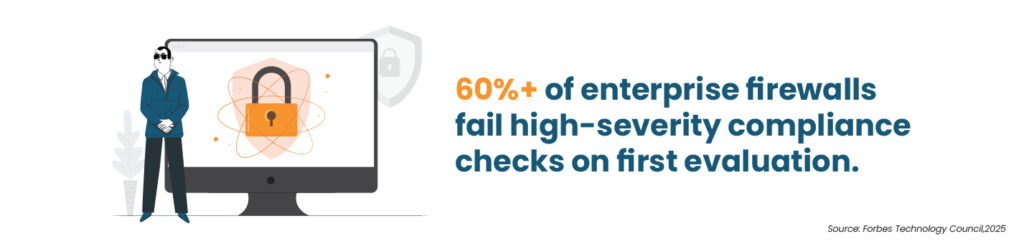
A properly run managed firewall service typically covers:
- Traffic and log review — someone reading the data, not just archiving it
- Rule cleanup and lifecycle management — retiring outdated access rules before they become a problem
- Firmware and patch scheduling — updates on a defined timeline, not whenever someone gets around to it
- Escalation processes — structured response when something actually goes wrong, with clear ownership
- Compliance reporting — documentation formatted for audits, not just internal records
For those supporting client environments, there’s a second layer of value that doesn’t get talked about enough. Consistent configuration templates across sites. Fewer tickets bouncing up to senior engineers over things that should have been caught at the firewall level. Change histories that hold up when an auditor starts asking questions. Over time, that operational consistency has a real impact on how a technical team spends its hours.
7 Top Managed Firewall Service Providers in 2026
1. Infrassist
Infrassist has a clear operational focus: firewall management handled properly, documented consistently, and built around the way support teams actually work. Every process, from reporting formats to escalation paths, is designed to integrate into existing workflows rather than disrupt them. That’s a harder thing to pull off than it sounds, and it’s where a lot of providers fall short.
The service runs across five defined phases: initial setup and deployment, ongoing maintenance, technical support through your ticketing system, 24/7 monitoring via central management portals like Sophos Central and Forti Analyzer, and periodic firewall audits to standardize configurations across environments. Deliverables are structured—weekly and monthly reports on performance, threats, and unused rules, not vague summaries. An MDR team sits above the standard admin layer. Threats get assessed and escalated where needed, rather than generating an alert that sits in a queue.
150+ partnerships globally. 30,000+ nodes under management. ISO 27001:2022 certified. Platform-agnostic across firewall types and platforms like Sophos, Fortinet, pfSense,, Palo Alto, Cisco, and others—no forced migration required to bring them in. If the goal is firewall management that slots into your operation without friction, Infrassist is the strongest starting point on this list.
Why Infrassist?
- Purpose-built service model — every process designed around how support teams actually operate
- Five-phase service model with defined deliverables at each stage
- MDR-backed threat assessment and escalation, not just passive alerting
- Platform-agnostic: Sophos, Fortinet, pfSense, Palo Alto, Veeam and more — no forced migration
- ISO 27001:2022 certified with 100+ engineers managing 30,000+ nodes
- Integrates into your existing ticketing system and tool stack
2. Ntiva
Ntiva is a broad managed IT and cybersecurity provider. Firewall management is one piece of a larger stack that also covers endpoint protection, SIEM, and compliance. That’s its appeal for some and its drawback for others—if you’re consolidating vendors and want one relationship covering multiple IT disciplines, Ntiva works well. If you specifically need firewall depth, a more focused provider will probably be a better match.
Compliance documentation is a genuine strength. Regulated industries tend to get on well with them, and the North American footprint gives them multi-region capability that smaller providers can’t match.
Why Ntiva?
- Firewall management as part of a wider managed IT and security engagement
- Well-structured compliance documentation across multiple regulatory frameworks
- Good fit for consolidating vendor relationships under one managed services provider
- 24/7 coverage with escalation support included in the service
- Multi-region capability across North America
3. Netsurion
Netsurion’s firewall services are designed for environments with a lot of moving parts—retail chains, healthcare groups, businesses running 20 or 30 locations where the hard part isn’t depth at any one site, it’s visibility across all of them at once. Their 24/7 SOC handles the monitoring end, and the EventTracker platform ties network and endpoint data together in one place.
PCI-DSS and HIPAA are real areas of experience here, not just marketing language. Single-site businesses may find the platform more infrastructure than they actually need.
Why Netsurion?
- SOC-backed monitoring built specifically for distributed, multi-location environments
- EventTracker platform: network and endpoint visibility in a single interface
- Documented experience with PCI-DSS and HIPAA in healthcare and retail
- Centralized reporting across many sites simultaneously
- 24/7 threat detection with structured escalation workflows
4. Omega Systems
Omega Systems is a mid-Atlantic provider that has grown its security capabilities meaningfully over the last few years. Their managed firewall offering is part of a program that also includes vulnerability management and security awareness training, which suits clients who don’t want to manage three separate vendor relationships for what is essentially one connected security problem.
They work best with smaller organizations in their region that want consistent engineers, not a rotating help desk. Multi-region or complex multi-vendor environments are outside what they’re built for.
Why Omega Systems?
- Firewall management paired with vulnerability management and security awareness training
- Consistent engineer relationships — same people, same context, across engagements
- Practical fit for SMBs in the mid-Atlantic seeking bundled managed security coverage
- Holistic security approach rather than treating each discipline as a separate product
- Approachable for organizations that don’t want enterprise-scale overhead
5. Evolve IP
Evolve IP takes a cloud-first approach. For businesses that have already moved a meaningful share of workloads off-premises, the traditional perimeter firewall model has gaps—and that’s what Evolve IP is set up to handle. Next-generation firewall management sits alongside their cloud infrastructure and unified communications services, which works well if you want one vendor handling the security and operational side of a hybrid environment.
Still running mainly on-premises? Other providers on this list will be a stronger fit. Evolve IP earns its place for hybrid and cloud-heavy setups where the perimeter no longer has a clean edge.
Why Evolve IP?
- Managed firewall built for hybrid and cloud-first network environments
- Combines next-gen firewall management with cloud infrastructure and unified communications
- Addresses the security gaps that open up when workloads shift off-premises
- Single-vendor model for organizations mid-migration or post-migration
- Scalable coverage that adjusts as cloud adoption increases
6. Thrive Networks
Thrive targets mid-market organizations that need enterprise-level security but don’t have an enterprise-level internal team to run it. Firewall management is part of their ThriveSecure program, which is backed by multiple SOCs running around the clock. It’s not sold as a standalone service—it’s part of a broader security posture engagement.
If you only want firewall management and nothing else, there are simpler options. If you want a proper security partner that handles firewall alongside endpoint, threat intelligence, and compliance, the depth is genuinely there.
Why Thrive Networks?
- Firewall management within a full enterprise-grade security posture program
- Multi-SOC infrastructure for genuine 24/7 monitoring coverage
- Strong fit for mid-market organizations outgrowing their current security model
- ThriveSecure combines firewall, endpoint, and threat intelligence in one engagement
- Defined SLAs for escalation and incident response
7. Corsica Technologies
Corsica does their best work with compliance-heavy organizations—finance, healthcare, legal—where documentation discipline matters as much as the security coverage itself. Every change gets logged. Log reviews follow a structured cadence. Reports are built to satisfy auditors, not just to summarize activity.
Their size is an advantage in this context. Engineers who handle your environment know your environment. No re-explaining history on every ticket. For clients who’ve grown frustrated with the faceless service desk experience at larger providers, that continuity is worth paying attention to. Not the right fit for large multi-site deployments, but for compliance-focused SMBs, consistently reliable.
Why Corsica Technologies?
- Audit-ready change documentation and log review built into standard workflows
- Compliance reporting mapped to PCI-DSS, HIPAA, and similar frameworks
- Dedicated engineer continuity — the same people, familiar with your environment
- Track record in finance, healthcare, and legal sectors
- Right-sized for compliance-heavy SMBs that need precision over platform scale

What to Ask Before You Sign Anything
Provider descriptions tell you what a service includes. The questions below tell you how it actually works when something goes wrong at midnight.
- Does the provider support your current firewall platform, or will you need to migrate first?
- Who owns an active incident outside business hours, and what does real response time look like?
- Are reports client-ready out of the box, or do they need manual work before sharing?
- Is monitoring continuous, or are there gaps in after-hours coverage?
- Do they work within your existing ticketing system, or do you adapt to theirs?
Ask these questions in an actual conversation. The answers will tell you more about day-to-day working reality than any feature list will.
Final Thoughts
Seven providers, seven different service models. Some specialize tightly; others package firewall management inside a broader offering. Some are built for scale across many locations, others for compliance precision, others specifically for MSP-first workflows.
The right fit depends on your environment and how external support needs to integrate with your team. Start with the evaluation questions, shortlist two or three that match what you’re actually looking for, then go deeper from there.