Your business runs on applications and data that need to work every single day, all day long. Fast performance, tight security, constant availability—these aren’t things that impress customers anymore. They just expect them.
Here’s what trips up a lot of businesses after they move to the cloud: the infrastructure still needs someone managing it. A lot of managing, actually.
As a business leader, you’re likely facing one of two scenarios: either you’re investing heavily in specialized cloud talent to manage your Azure environment, or your existing IT team is overwhelmed with operational tasks while strategic projects keep getting delayed.
Microsoft Azure Managed Services shift that operational burden from your internal team to Microsoft and its partner ecosystem through automated systems backed by Azure experts. This fundamentally changes how you allocate your technical resources and how quickly you can act on business opportunities.
Understanding what these services deliver and when they make strategic sense for your business directly impacts your ability to scale operations, maintain compliance, and focus your IT talent on initiatives that drive revenue instead of just maintaining infrastructure.
What Microsoft Azure Managed Services Actually Mean
Microsoft Azure Managed Services are comprehensive operational support offerings that handle the day-to-day running of your Azure environment. These services cover infrastructure management, security monitoring, compliance maintenance, performance optimization, cost control, and expert technical support—essentially everything needed to keep Azure environments running smoothly.
The key difference from standard Azure: you’re not just buying cloud infrastructure, you’re buying operational management of that infrastructure. It’s the difference between renting a car (you drive, maintain, fuel it) versus hiring a car service (someone else handles all that while you focus on where you need to go).
With standard Azure, you set up what you need from the Microsoft Azure’s pool of resources and then your team runs it. With Azure Managed Services, provisioning still happens based on your requirements, but ongoing operations—monitoring, updates, troubleshooting, optimization—get handled through a combination of automation and Azure specialists.
Strategic control stays with you and operational execution shifts to the service provider.
How Azure Managed Services Work
Understanding how Azure Managed Services work helps explain why they’re different from traditional IT operations or basic cloud services.
Three layers make it work.
Monitoring the infrastructure and applications hosted on Azure sits at the bottom layer. Systems keep an eye on your infrastructure every single hour using Azure’s own tools. How things perform, security stuff happening, what resources you’re using, whether apps are healthy—it all gets tracked as it happens.
Automated systems handle the usual responses. Anything needing human judgment goes to specialists.
Staying ahead of problems makes up the second layer. Security patches don’t wait around for your team to find time. Updates happen in windows you control.
The system tunes itself automatically and the infrastructure gets bigger when more people use it and shrinks when they don’t. Backups run on schedule without anybody starting them.
Experts jumping in creates the third layer. Azure specialists deal with messy problems that automation can’t fix.
Azure specialists handle complex issues that automation can’t resolve. They understand Azure architecture deeply—specific service configurations, common failure patterns, optimization techniques, and security implementations that work in production environments.
For organizations planning cloud transitions, Azure Migration Services work alongside managed services to help move workloads systematically while ensuring operational continuity during and after migration.
You access information through the Azure Portal, which shows current system status, recent changes, upcoming maintenance schedules, cost tracking, and performance metrics.
When you need to decide something—like how much capacity, changing security rules, approving budget—you get advice explained in business terms, not tech talk.
The operational approach shifts from reactive troubleshooting to strategic planning. Your team stops responding to alerts at odd hours and starts making informed decisions about capacity, architecture, and resource allocation while daily operations run smoothly without constant intervention.
What Managed Azure Services Cover
Azure Managed Services handle everything operational:
Infrastructure:
Virtual machines, storage, networks, operating systems maintained systematically. Updates and patches happen automatically.
Security and staying compliant:
Identity management, threat monitoring, firewall configuration stay current. Includes maintaining security baselines, responding to threats, keeping audit trails updated.
Watching costs:
Continuous spending monitoring with regular reporting. You get recommendations on overspending or underutilizing resources before budget problems hit.
Tracking performance:
Round-the-clock observation using Azure Monitor. Problems get spotted before users notice, performance baselines maintained automatically.
Protecting data:
Automated backups, current disaster recovery procedures, business continuity planning. Recovery points tested regularly so they work when needed.
Automation setup:
Infrastructure as Code and CI/CD pipelines make deployments reliable. Cuts deployment time from hours to minutes while reducing human error.
Expert help:
24/7 access to Azure specialists who’ve solved similar problems hundreds of times.
When operational tasks get handled systematically, teams can focus on building things that affect business results.
When Does Microsoft Azure Managed Services Fit Your Business
Some business situations make Microsoft Azure Managed Services strategic instead of just nice to have.
IT stuck on maintenance
Technical people spending most of their time keeping systems going instead of building new stuff means you’re falling behind competitors who freed their teams up to try new things. This goes past being efficient—it hits your competitive spot in the market.
Growth hitting infrastructure walls
Looking to double in the coming years? Your IT shouldn’t have to double with it. Managed Azure Services cost what you use. Hiring costs the same whether you’re busy or not, takes months, plus you’ve got hidden costs getting new people up to speed.
Compliance getting stricter
Healthcare dealing with HIPAA audits, financial companies handling PCI DSS rules, businesses going into regions with tough data laws—Azure Managed Services already include compliance stuff built in. Building the same things yourself takes serious money in technology and keeping up with compliance.
Can’t find cloud people
Lots of places struggle getting qualified Azure talent. Fighting for experienced cloud professionals pushes costs up and drags out hiring. Microsoft Azure Managed Services give you access to expertise without the hiring fight or worrying about people leaving.
Disaster recovery has holes
Plenty of companies find out their disaster recovery ideas don’t work when they actually test. Can you honestly say systems would come back fast after something major breaks? Managed services give you disaster recovery that’s automated and tested all the time, so it works when you need it.
Business goes up and down
Industries that change with seasons—hotels, stores, schools, travel—pay for fixed infrastructure all year even when business is slow. Managed Azure Services match costs closer to real business by automatically getting smaller during quiet times.
Moving to Azure from on-premises or other cloudse
Organizations using Azure Migrate to assess and move workloads often adopt managed services simultaneously, ensuring new Azure environments get proper operational support from day one rather than discovering management gaps after migration completes.

What You’re Really Spending on Azure Managed Services
Here’s what you’re comparing when looking at costs.
Experienced systems administrators represent significant annual investment when you count salary, benefits, and overhead. But Azure environments need multiple specializations—database administration, network security, container orchestration, compliance management, disaster recovery expertise.
You’re not comparing managed Azure services costs against what one person makes. You’re comparing against the whole operational team that the enterprise cloud actually needs.
Think about costs that don’t show up in regular budget reviews. What does it cost when something breaks, and your team can’t fix it fast?
What happens from a security breach because patches didn’t get applied? What occurs during compliance audits when controls aren’t kept up?
Risk costs are real even when they don’t appear in monthly budget meetings.
Forrester’s Total Economic Impact study followed organizations using Azure Managed Services for three years and wrote down real results:
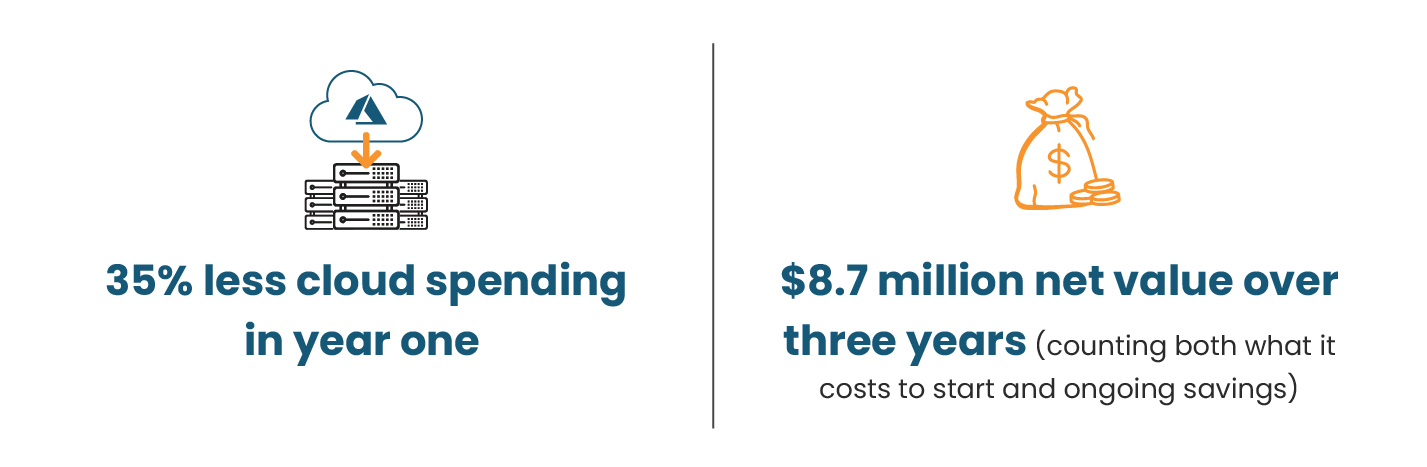
Numbers came from following real companies through actual operations, not guesses. Savings came from using resources better, cutting out operational overhead, less downtime, fixing problems faster.
Azure Managed Services Value You Won’t See in Spreadsheets
Some things matter a lot but don’t show clearly in cost comparisons.
Getting to market faster matters
Building production environments for launching new products or expanding regions takes days with Azure Managed Services instead of months the old way needs. When competitors come into your market or chances pop up, how fast you move matters. Infrastructure shouldn’t hold you back.
Lowering risk has value
Automated backups and disaster recovery with constant testing cut out human mistakes systematically. When systems get configured wrong, backups get missed, or recovery procedures weren’t tested and problems happen—business impact can be bad. Lost money, customers not trusting you, penalties from regulators. Managed Azure Services drop these risks through systematic automation plus expert watching.
What you could do instead affects competition
Think about what your IT team could build spending less time on infrastructure. Better customer tools? Analytics making smarter business calls? Faster answers to requests from business units?
Being agile becomes real
Markets shift, customer wants change, new competitors show up. Microsoft Azure Managed Services make it easier to change direction, test new ideas, or grow fast when chances come. Your infrastructure helps you instead of blocking what you can do.
Deciding What Fits
The question isn’t whether managed services work generally—it’s whether they fit your specific business situation.
Ask yourself:
- Where does your IT team’s time actually go? If significant effort goes toward maintaining infrastructure instead of building differentiating capabilities, that’s your signal.
- Can your current IT operation scale with business growth without proportional headcount increases?
- Are compliance demands intensifying? What would building those controls internally cost versus getting them with Azure Managed Services?
- Can you realistically attract and retain cloud specialists in your market? Factor in recruitment costs, training time, retention bonuses, and knowledge loss.
Most companies find infrastructure management enables operations but doesn’t differentiate the business. Hotels don’t win customers by managing Azure better than competitors—they win on guest experience and service quality.
Managed Azure Services create value by freeing organizational focus for what actually sets you apart from the competition.
Moving Forward
Microsoft Azure Managed Services won’t fit every business. Some organizations built deep infrastructure knowledge worth using. Some workloads genuinely benefit from hands-on managing.
However, companies focused on growth, facing compliance pressure, struggling with operational overhead, or stuck because of infrastructure limits find that managed Azure services solve real problems eating time, budget, and organizational attention daily.
This connects directly to business goals. Your specific aims should drive the choice—it’s a business call about operational approach and where you want technical talent pointed.