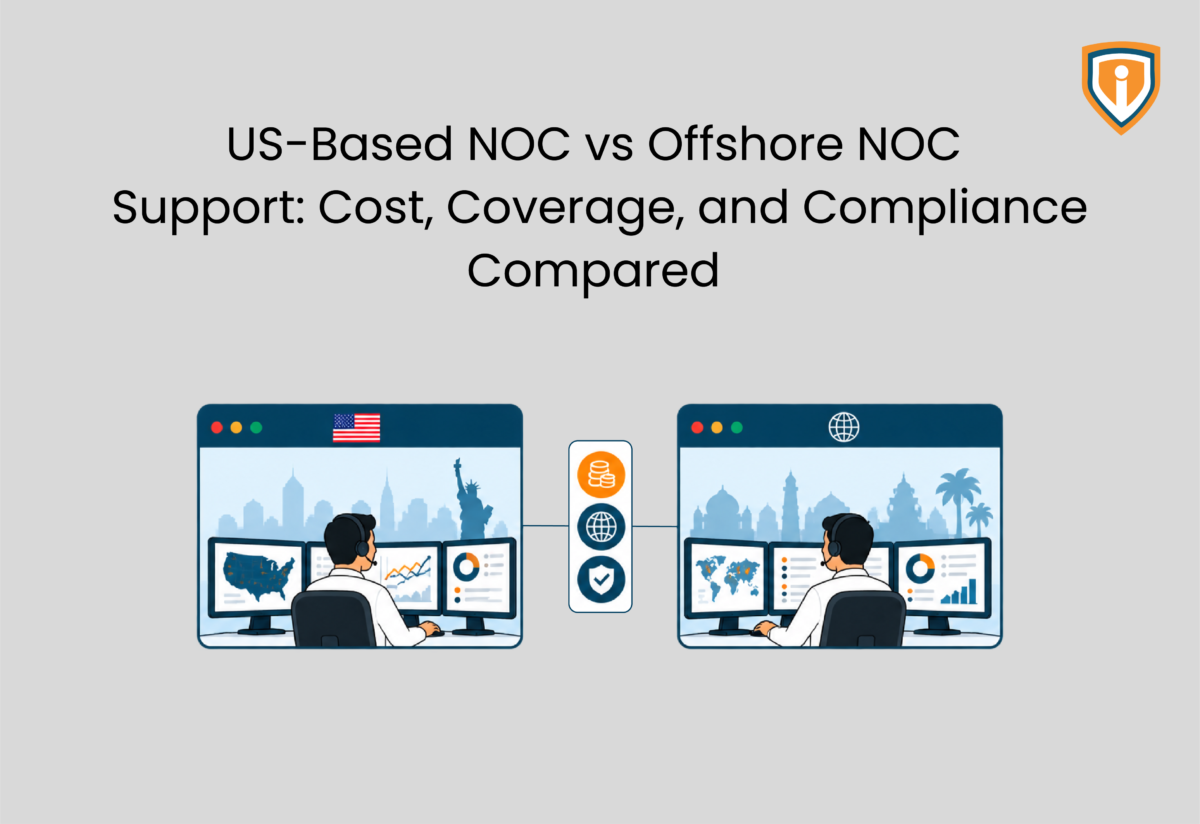
A US-based Network Operations Center (NOC) provides domestic IT monitoring and incident management, whereas an offshore NOC delivers these outsourced services through remote international teams.
Every MSP eventually runs into the same question while shopping for NOC coverage: does it matter if the engineers answering the ticket queue sit in Ohio, India, or Philippines? The honest answer is that it matters less than the marketing pages suggest, and more than a lot of vendors admit.
The real debate around US-based NOC vs offshore NOC support rarely comes down to national pride.
It comes down to three questions: whether coverage genuinely lines up with when clients experience outages, whether the price gap holds up once turnover gets counted, and whether a provider based outside the US can clear the compliance bar a contract demands. A client mid-outage does not care which country picked up the phone. They care whether the person on the other end can fix it and how well.
Understanding US-Based and Offshore NOC Services for MSPs
A US-based NOC keeps every tier from 1 through 3 on domestic payroll, working domestic shifts. An offshore NOC moves some or all of that staffing overseas, usually to India, the Philippines, or Eastern Europe, chasing a wage gap wide enough to reshape a services budget on its own.
Neither model wins automatically. A tight offshore NOC will outperform a thin US shop more often than people expect, and the reverse holds too. The real dividing line is architecture: who’s actually awake and able to act when a client needs help, and how much technical depth and operational structure sits below the alert-monitoring layer.
Geography is really a proxy for a bigger decision. Before MSPs even get to onshore versus offshore, they need to settle whether they’re running an in-house or outsourced NOC model and a co-managed or fully managed NOC in the first place.
Coverage: Does an Offshore NOC Cover US Business Hours?
On paper, yes. Nearly every offshore NOC provider advertises round the clock monitoring, and most genuinely staff a live queue at all hours. The catch: coverage measured in headcount is not the same as coverage measured in seniority.
24/7 is a myth in the way most MSPs picture it. Overnight queues offshore are often staffed by junior Tier 1 engineers working scripted runbooks, while the Tier 3 specialists who can chase down a routing loop under pressure are clocked in during their own local daytime, a window that overlaps with the US overnight shift, not the US workday.
The alert gets logged the moment a client’s network goes down at midday, and the engineer who could solve it may be off shift on the other side of the globe.
That gap shows up in outage costs more than in SLA reports. Uptime Institute’s 2026 Outage Analysis found that 57% of respondents’ most recent major outage cost more than $100,000, and for a second straight year, roughly one in five outages topped $1 million.
What a Major Incident Costs, and Who’s Awake to Stop It
| US-Based NOC | Offshore NOC | |
|---|---|---|
| Senior engineer availability during the incident | Tier 3 engineers active and on shift when it happens | Often clocked out; junior staff triage and escalate to day shift |
| Immediate remediation | Fix applied directly, no handoff wait | Delayed until senior staff come online |
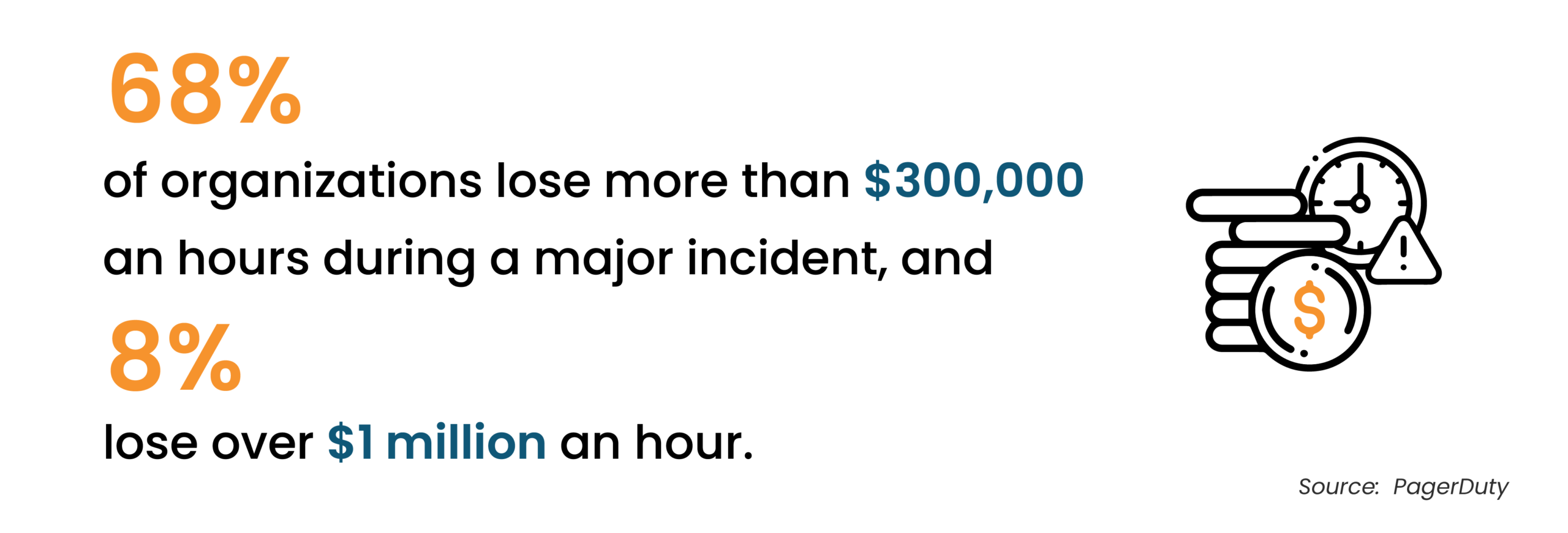
When a NOC’s most capable engineers are off shift the moment a US client’s incident starts, every one of those minutes compounds.
- Junior alert triage available at all hours versus senior engineers actively working through the client’s own business day
- A queue that logs and escalates versus a queue that logs, escalates, and remediates without waiting on a handoff
- Shift overlap built around the client’s time zone versus shift overlap that only happens to line up
A NOC as a service model built around US business hours removes the guesswork, because the senior bench is staffed to match when clients actually call, not when it is convenient to schedule from a payroll standpoint.
Cost: How Much Cheaper Is Offshore NOC?
Numbers vary by provider and country, but the general shape holds. US-based NOC pricing tracks close to US technical salaries, in the vicinity of $73,000 to almost $97,000 a year loaded per engineer before overhead. Offshore NOC pricing runs meaningfully lower per engineer, once you compare the same role and seniority level on both sides, which is exactly why the model exists.
| Cost Factor | US-Based NOC | Offshore NOC |
|---|---|---|
| Base staffing cost | Higher, follows US technical salaries (roughly $73,000–$97,000 a year per engineer) | Lower, often 40 to 60% less per engineer on an annual, loaded-cost basis |
| Onboarding and retraining | Lower, since less frequent turnover means fewer new hires to train | Higher, since more frequent turnover means more retraining cycles |
| Escalation speed on complex issues | Faster, no handoff across shifts | Slower if senior staff are off shift |
| Total cost over 12 months | Higher upfront, more predictable | Lower upfront, less predictable with high turnover |
What gets left out of the pitch deck is total cost, not sticker cost. A cheaper hourly rate does not help much if engineer turnover forces constant re-onboarding, or a ticket bounces between tiers because nobody local to the client’s time zone is authorized to close it.
Cost comparisons that stop at headline rate are, without a shadow of a doubt, the ones that get MSPs into trouble a year in. The NOC KPIs and metrics that actually predict long-term cost, MTTR, SLA compliance rate, and first-touch resolution, rarely show up on a pricing sheet.
| Model | Pros | Cons |
|---|---|---|
| US-Based NOC | Perfect timezone alignment, seamless communication, and straightforward compliance. | Higher labor costs and harder to staff 24/7 shifts affordably. |
| Offshore NOC | Major cost reductions and easy scalability for around-the-clock coverage. | Management overhead for compliance and potential communication nuances. |
Security and Compliance: Can an Offshore NOC Meet SOC 2, ISO, or HIPAA?
Short answer: yes ! But only with the right paperwork in place, and MSPs still have to verify it themselves rather than take a vendor’s word for it. HIPAA doesn’t care where a business associate sits. Domestic or international, the same rules apply to how protected health information gets handled.
According to the US Department of Health and Human Services, the core requirement is a signed business associate agreement (BAA) and adherence to the Security and Privacy Rules, rather than a geographic restriction on the location of the desk. SOC 2 and ISO works on the same logic: it certifies controls, not country of origin.
Where offshore NOC providers run into trouble is enforcement, not the letter of the regulation. A US regulator has limited reach into an overseas facility, which shifts the burden onto the MSP to verify controls directly rather than assume compliance because a website page says “SOC 2 certified.”
- 1. A signed business associate agreement covering every entity in the chain, not just the primary vendor
- 2. A recent, independent SOC 2 Type II report, not a self-attestation
- 3. Documented data residency and access controls, including whether staff outside the contracted region can touch client data at all
Skipping this step is one of the more daunting mistakes an MSP can make, since liability for a breach does not transfer cleanly just because the NOC is a subcontractor.
Ticket Punching vs. True Incident Remediation
This distinction matters more than the coverage debate itself. Ticket punching means an engineer logs the alert and throws it back to the MSP without touching the underlying system. True incident remediation means the engineer logs in and fixes the server, firewall rule, or failed service directly, closing the loop instead of passing it along.
Offshore NOC providers get accused of ticket punching more often, and the accusation is sometimes fair, though rarely for the reason people assume. It is not usually a skill gap. It is a permission gap. Junior overnight staff often lack the access to make configuration changes, so the safest move is to log and escalate, even when the fix sits within their reach.
- 1. The engineer isolates root cause using a structured runbook rather than guessing
- 2. The engineer has the access and authority to apply the fix without waiting on a human handoff
- 3. The client gets a plain language summary of what happened and what was done, not just a closed ticket
An MSP evaluating any provider should ask directly what percentage of tickets get resolved without escalation. That single number says more about NOC quality than most of what shows up on a sales call.
Staffing and Turnover: Why It Affects Your Clients
Turnover is the quiet variable that undoes a lot of otherwise reasonable NOC decisions.
Offshore support hubs, particularly in high growth tech labor markets, frequently sit at the higher end of that range, since demand for English speaking technical talent outpaces supply.
- A different engineer on every call, each relearning the client’s environment from a runbook instead of institutional memory
- Slower time to resolution while a newly onboarded hire ramps up on unfamiliar tooling
- Documentation gaps when an engineer who understood a client’s quirks leaves before writing it down
A NOC that loses staff at a high rate cannot deliver the consistency clients actually notice, and MSPs that have gone through migrating NOC providers without disrupting service know exactly how much that consistency is worth protecting in the first place. Low turnover is not a nice to have. It is close to the single biggest predictor of whether a client’s experience stays stable month over month.
Hybrid and Co-Managed NOC Models: The Middle Ground
Most of the framing above sets up a false binary. In practice, the strongest NOC setups blend the two.
A hybrid NOC model, sometimes called a co-managed NOC, pairs offshore cost efficiency for high volume, lower complexity monitoring with a senior bench that stays active during US business hours, regardless of where that bench sits physically.
Infrassist runs this as a Time Zone Aligned Hybrid NOC: engineers staffed to be fully available and authorized to remediate during the hours US clients are actually experiencing incidents, not staffed around a schedule that is convenient for payroll but disconnected from when problems happen.
The model works because it separates two things that get conflated constantly: where an engineer is located, and when that engineer is available and authorized to act. A time zone aligned team closes the coverage gap pure offshore staffing struggles with, while still capturing a meaningful slice of the cost advantage that made offshore attractive.
How to Vet a NOC Provider (US-Based or Offshore)
| What to Check | Why It Matters |
|---|---|
| Tier 2 & 3 shift schedule against your clients’ business hours | Confirms senior staff are active when incidents happen, not just monitoring |
| Ticket resolution rate without escalation | Separates true remediation from ticket punching |
| Staff turnover rate, requested directly | Predicts the consistency clients will actually experience |
| Compliance documentation: SOC 2 Type II or BAA | Confirms controls exist beyond a marketing claim |
| Data residency and access policy | Clarifies who can touch client data, and from where |
A few questions worth asking directly on every vendor call:
- 1. What percentage of your Tier 3 staff work hours overlap with mine, not just your monitoring desk?
- 2. Can I see your most recent SOC 2 Type II report or an equivalent independent audit, not a summary page?
- 3. What is your engineer turnover rate for the last 12 months, and how do you calculate it?
Vendors that answer plainly, with numbers and facts rather than reassurance, tend to be the ones worth signing with. Vendors that redirect to a case study instead are worth a second look, and outsourced NOC services that publish this information upfront save both sides a slew of back and forth during procurement.
Will Your Clients Know If Your NOC Is Offshore?
Usually not. A well-run offshore NOC is set up so it doesn’t matter. Clients pick up on tone. They pick up on how fast someone responds. An accent is often noticeable, but it doesn’t affect the fix, and since engineers work inside the MSP’s own systems over VPN, a timestamp doesn’t reveal where the desk sits either.
If the engineer on the other end fixes the problem, explains it in plain terms, and follows up without a nudge, the location of the desk becomes irrelevant.
- Communication that reads as scripted or translated rather than natural, especially during a high stress incident
- A gap between an alert firing and a clear explanation of what’s happening, regardless of shift
- A support experience that feels different depending on which shift picked up the ticket
None of that is inevitable, or unique to offshore staffing. A poorly managed US-based NOC produces the same complaints. What actually keeps a NOC invisible to end clients, in the good sense, is consistency of process and communication, not the passport of the engineer running the ticket.
Schedule Your NOC Migration Strategy
Ready to see what Time Zone Aligned Hybrid NOC coverage looks like for your client base?
The Bottom Line
Coverage gaps, real cost, and compliance paperwork decide this comparison, not geography on its own. Offshore staffing saves money on the base rate. Senior engineer coverage during client hours is what keeps escalations fast, whether that coverage is staffed onshore or through a time zone aligned offshore team. A hybrid setup tends to split that difference: a senior bench on call during business hours, without pricing every seat at the full US rate.