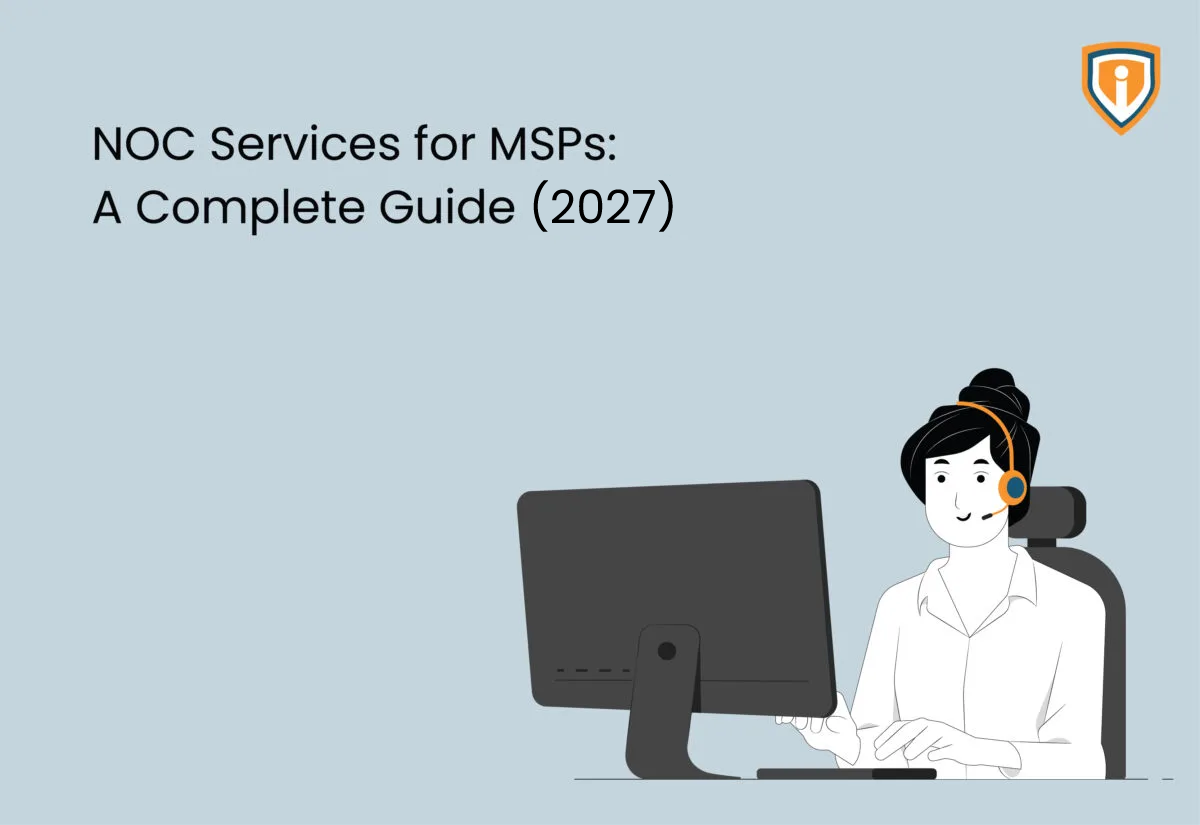
Managed NOC services give MSPs an external team to monitor, maintain, and troubleshoot client IT environments around the clock. A managed NOC can handle alert monitoring, remediation, patching, backups, incident management, RMM administration, and security-related tasks, helping MSPs expand service capacity without building and staffing a 24/7 NOC in-house.
Key Takeaways
- Managed NOC services allow MSPs to have 24×7 monitoring and operations without setting up their own NOC.
- NOC staff can manage alert management, fix issues, apply patches, backup management, RMM, and even incident management.
- Outsourced services become relevant when the client base grows faster than MSP can scale its engineering department.
- A dependable NOC vendor is one which is integrated with the MSP’s tools, processes, service level agreements, escalations, and client deliverables.
- MSPs need to consider their total operational cost while comparing outsource NOC services with an in-house option.
With more MSP clients come more devices, notifications, tickets, maintenance tasks, and even out-of-hours support to manage operations flawlessly.
Dealing with increasingly complex client environments is demanding work. The MSP could be handling cloud platforms, physical IT infrastructure, remote endpoints, backups, and several different monitoring tools simultaneously. And once you’ve reached this point, considering professional NOC services becomes imperative.
A managed NOC service is an outsourced solution, where an MSP has its own NOC staff. They’re responsible for monitoring and managing the environment all day every day. Their responsibilities may range from managing alerts to remediations, patching, backing up data, running RMM processes, and managing incidents.
In fact, modern NOCs are going beyond just monitoring the dashboard. With automation, advanced monitoring tools, and AI-powered analytics, these teams are able to detect and resolve issues faster.
The main question for MSPs, however, is whether the NOC partner of their choice can take the workload off their plate without affecting service quality and client control. Let’s learn more about what managed NOC services for MSPs mean and why they remain indispensable in modern times.
What Are NOC Services?
NOC stands for Network Operations Center. In simple terms, it is a team of experts that keeps an eye on a client’s IT environment and deals with issues as they spring up.
This can mean monitoring servers, networks, endpoints, applications, firewalls, and other infrastructure. When something goes wrong, the NOC team investigates the alert, fixes what it can, and escalates problems that need deeper expertise.
The work is mostly remote. Engineers don’t need to be sitting at the client’s office to spot a failed backup, a server issue, a device going offline, or a missed patch.
For an MSP, a NOC can be an extension of the existing technical team. The MSP still manages the client relationship and decides how services are delivered, while the NOC takes on some of the monitoring and day-to-day operational work.
Why Are NOC Services Necessary?
An MSP has a limited number of technicians who are expected to watch multiple client environments at once.
The trouble is, IT problems don’t stick to business hours. For instance, a server can go down at 2 a.m. just as easily as it can at 2 p.m. Someone still has to notice it, check what happened, and decide what needs to be done about it.
This is one of the main reasons MSPs use NOC services. Instead of having their own technicians constantly watching dashboards and responding to routine alerts, they can have a NOC team handle this work. It also means problems can be picked up and resolved before it becomes an emergency.
What Do Managed NOC Services Include?
There isn’t one fixed list of NOC services. What a provider handles depends on the MSP’s setup, tools, clients, and service agreement.
Most managed NOC services cover some combination of the following:
- Monitoring and Alert Management: The team monitors servers, networks, endpoints, applications, and other devices. When an alert comes in, engineers check whether it needs action or can be closed as a false or non-critical alert.
- Backup Monitoring: The NOC checks whether scheduled backups are completing successfully and flags failures that need attention. Some providers also help with recovery testing and disaster recovery tasks.
- Patch Management: Engineers monitor systems for missing patches and help schedule or deploy updates. Routine patching can often be handled through RMM tools, while more sensitive updates may need manual review.
- Threat Monitoring: NOC teams may monitor security-related alerts and investigate unusual activity. More advanced security investigation and response may sit with a dedicated SOC, depending on the provider’s setup.
- Incident Management: When something actually goes wrong, the NOC investigates the issue, follows the agreed response process, fixes it if it falls within its scope, or escalates it to the appropriate engineer.
- RMM Management: Since most MSPs already use an RMM platform, the NOC works within those tools to monitor devices, respond to alerts, run routine tasks, and keep track of client environments.
The important distinction is that a NOC isn’t simply a room full of people watching screens. The useful part is what happens after an alert appears: someone has to determine whether it matters, take the right action, and know when to escalate it.
Tools Needed to Set Up Your NOC

Setting up a NOC requires a healthy toolkit to ensure efficient monitoring, management, and response. Key tools include:
1. Remote Monitoring and Management (RMM) Tools
RMM platforms enable MSPs to monitor client devices and networks remotely. These tools provide real-time alerts, automate routine tasks, and streamline issue resolution.
2. Professional Services Automation (PSA) Software
MSPs should have a PSA software to manage customer data, get transparency and insights into your clients’ operations. The software integrates ticketing, client management, and resource allocation, for a free-flowing seamless collaboration.
3. Backup and Disaster Recovery (BDR) Solutions
Reliable backup tools on-premise and on cloud across varied platforms to ensure data recovery in case of hardware failure, cyberattacks, or natural disasters.
4. Patch Management Tools
Automated patch management solutions like Ivanti or ManageEngine keep systems up-to-date with the latest security updates and software fixes.
5. Endpoint Detection and Response (EDR) Solutions
EDR platforms, to provide advanced threat detection and response capabilities for endpoints.
6. Collaboration Tools
Platforms like Slack or Microsoft Teams facilitate communication and collaboration among your NOC staff, ensuring rapid response to incidents.
7. Reporting and Analytics Tools
Reporting tools like Tableau or Power BI provide actionable insights into system performance, help you as an MSP make informed, data-driven decisions.
Why Do MSPs Outsource NOC Support?
The decision usually comes down to capacity.
An MSP can manage monitoring internally for a while. Then the client base grows, alert volumes increase, and tickets start getting generated during nights, weekends, holidays, and sick days. Hiring one more technician does not solve the problem because you need enough people to cover the shifts consistently.
Finally, outsourced NOC support starts making sense. The MSP gets a team handling the work that does not always require its senior technicians: monitoring, alert triage, routine remediation, patching, backup checks, device management, and first-level incident response.
There is also the hiring problem. Finding engineers is one thing, keeping enough of them to maintain 24/7 coverage is another. Attrition, leave, training, and salary expectations all become part of the operating cost.
No wonder, for many MSPs, outsourcing is simply a way to avoid building that entire function internally.
What Challenges Do MSPs Face When Outsourcing NOC Support?
Outsourcing has its own problems. The biggest one is how much work actually gets taken off the MSP’s plate.
A provider might advertise 24/7 monitoring, but if its technicians only acknowledge alerts and create tickets, the MSP still has to investigate and fix the underlying issue. This isn’t the same as having a NOC handle the operational workload.
The scope needs to be clear: Which alerts can the NOC close? What can engineers remediate without approval? When does something move to L2 or L3? Who contacts the client? What happens when an SLA is about to be missed?
The tools matter too. If the provider cannot work properly within the MSP’s RMM, PSA, ticketing, and documentation systems, engineers end up switching between platforms or recreating information. That adds unnecessary work.
Access is another issue. A NOC may need privileged access to client environments, so the MSP has to be comfortable with how accounts, credentials, MFA, logging, and access removal are handled.
And then there is accountability. The client still sees the MSP as the service provider. If the outsourced NOC misses an alert or handles an incident badly, the MSP owns that conversation.
In-House vs Outsourced NOC: Which Model Makes Sense?
Choosing an in-house model can be very intimidating over the course for an MSP because it would not only require you to hire the best engineers but also require you to update and train them. And let’s be honest, MSPs that want to focus on business strategy and growth wouldn’t have enough bandwidth to maintain a 24×7 in-house NOC. With an in-house model, you definitely get more control, but on the contrary, hiring new talent and meeting their financial and technical expectations will take taking most of your time and cost.
Outsourced NOC support services are offered by Master MSPs, and they have their own benefits. Below is a clear distinction on the difference between the two-
| Factor | In-house NOC | Outsourced NOC |
| Initial investment | Higher. Requires hiring, tools, infrastructure, and training. | Lower. Usually based on contract, per-device, per-hour, or service-based pricing. |
| Staffing | MSP handles recruitment, shifts, retention, and coverage. | Provider handles NOC staffing and shift coverage. |
| Control | Direct control over processes, tools, access, and personnel. | Control depends on the agreed scope, workflows, and access model. |
| 24/7 coverage | Requires enough employees to cover shifts, leave, weekends, and holidays. | Usually part of the service model, subject to the agreed SLA. |
| Technical expertise | Limited to the skills available within the internal team. | Can provide access to engineers with different technical skill sets. |
| Scaling | Requires additional hiring as monitoring volume increases. | Capacity can usually be increased as the MSP’s requirements grow. |
| Management overhead | MSP manages the entire NOC operation. | Provider manages day-to-day NOC operations and staffing. |
| Client relationship | MSP owns the full technical operation. | MSP retains the client relationship while the NOC handles the agreed operational work. |
How Infrassist Structures NOC Outsourcing: A 4-Phase Model
Most outsourcing engagements fail because they rush into execution. Infrassist takes a different approach altogether, built around stability, visibility, responsiveness, and clear ownership.
Phase 1: Delivery & Scope Definition
Every MSP is different, and so is every client stack.
In this phase, we:
- Conduct technical deep-dives into existing infrastructure
- Map out RMM, PSA, backup tools, and endpoint controls
- Document escalation rules, SLAs, alert thresholds
- Capture nuances for client-specific environments
Our Technical Account Manager oversees the full discovery process. Nothing is left to assumptions.
Phase 2: Onboarding and Custom SOP Integration
With the groundwork done, we transition into structured onboarding.
- Environment-specific protocols and SOPs are mapped to align with your infrastructure
- Test alerts and dry-run simulations are performed before going live
- Your team’s preferences on ticketing, alert notes, and escalations are baked in
- Knowledge base and runbooks in perfect synchronization with your internal practices
No off-the-shelf SOPs, and everything is molded to how you already operate.
Phase 3: Live Operations Begin
This is where the rubber meets the road.
- Real-time alert monitoring
- Health checks, patch cycles, backups, incident triage, all handled per scope
- Internal teams only looped in when necessary
- Transparent logs and ticket notes for every action
Phase 4: Optimization and Service Refinement
Support doesn’t stop at fixing issues. We keep improving what’s already in place.
- Bi-monthly reviews to analyze response patterns
- Feedback-driven updates to SOPs
- Documentation cleanup
- QBRs with insights, not fluff
This isn’t static. It evolves with your business because we’re not just vendors. We’re growth partners.
Need 24/7 NOC Coverage Without Building Another Team?
Get managed NOC support that fits your tools, workflows, clients, and existing MSP operations.
Conclusion
Managed NOC services can free up quite a bit of monitoring and IT activities from the MSP’s own team. However, everything related to the provider, the scope, the tools used, the escalation process, and the SLA must make sense before offshoring begins.
Proper configuration means moving the right processes onto the proper team. And managed NOC services are always a reliable choice here.