According to a 2024 Oxford Economics study, downtime costs Global 2000 enterprises a whopping $400 billion a year! That’s a $200 million average annual loss for each company.
Yet, many of these companies don’t maintain a full in-house IT team. They rely on tech every day, but even minor hiccups like password resets, patch updates, or brief downtime can hamper their daily operations without warning.
Fortunately, an outsourced IT helpdesk can save the day. With outsourced IT helpdesk support, businesses get dedicated tech support without hiring full-time staff.
It’s a smart way to keep operations running smoothly. When users hit a roadblock, they call the helpdesk, and the business stays on track, minus the overhead.
But there’s more to outsourced IT helpdesk support than meets the eye. In this post, we’ll shed light on the real value it offers to growing businesses.
Why IT Helpdesk Matters in Everyday Operations
An IT helpdesk looks simple on the surface: A user has a problem, and they call, message, or raise a ticket. Thereafter, a technician steps in and fixes it. But there’s more to what the IT helpdesk does.
The helpdesk is the backbone that keeps day-to-day operations from falling apart. When small tasks get delayed, productivity drops. For example, even a single login issue can hold up an entire team. Or, a software update that’s been missed for too long can create a security risk.
This is why many companies lean on either an outsourced IT helpdesk or outsourced IT helpdesk support to handle these constantly moving pieces.
Most businesses in today’s day and age rely on technology for everything, from email, billing, and sales to tracking, customer support, and remote collaboration. But not every company has the resources to set up a full in-house IT helpdesk with its ITSM tools, set and maintain SLAs, plan an escalation structure, triage issues, offer support after hours, and so on. However, when the system experiences a glitch, it needs to be fixed fast.
An efficient helpdesk can get teams back to work while minimizing hindrances and interruptions. There’s no need to wait for a technician to “get to it when they can.” Issues are logged, prioritized, and handled on time.
Further, a robust helpdesk monitors basic maintenance so that small problems do not become emergencies, whether it is regular patching, updates, user onboarding, or access control. These routine tasks look small, but they prevent bigger failures.
Their quick response times help employees feel supported. They know they can ask for help and actually get it without chasing anyone.
With outsourced IT helpdesk support, SMEs get support teams that are ready when users need them. The business keeps moving, work continues, and downtime stays low. The overall experience becomes less stressful for everyone involved.

What Outsourced IT Helpdesk Support Entails
For many SMEs, “outsourced” simply means partnering with a professional external team that handles IT issues remotely instead of employing a full in-house department. The technicians become an extension of the company’s team, ready to assist employees when IT-related problems appear.
Here’s how outsourced IT helpdesk support works in practice.
A typical setup includes:
- A dedicated remote team: The business receives access to technicians who respond to user issues, assist with troubleshooting, and resolve tickets without needing to be physically present.
- Centralized ticket management: Users log problems in a ticketing system. Tickets are prioritized, tracked, and resolved based on severity and impact. This prevents issues from getting lost or delayed.
- Faster response times: The goal is to get employees working again as soon as possible. When someone cannot access email, loses a password, or faces system errors, the helpdesk steps in quickly.
- Adherence to regulatory standards: A professional outsourced team is typically well informed about the latest data, privacy, and security regulations. They help businesses maintain adherence to all of them to avoid security and legal hassles.
- 24/7 Availability: Outsourced IT helpdesk services enable companies that work across time zones or handle urgent client work outside business hours. When problems occur at night or during weekends, support is still available. Work does not stop simply because the office is closed.
- Proactive Monitoring: Basic maintenance, updates, and alerts are handled in the background. This reduces the chances of unplanned downtime and helps spot issues before they become larger problems.
- Clear Service Level Agreements: Service Level Agreements, or SLAs, outline response targets and expectations. They define acceptable response and resolution times, communication standards, and what the business is entitled to. For SMEs, this adds predictability and accountability to the entire Outsourced IT helpdesk support relationship.
The Biggest Benefits of Outsourced IT Helpdesk
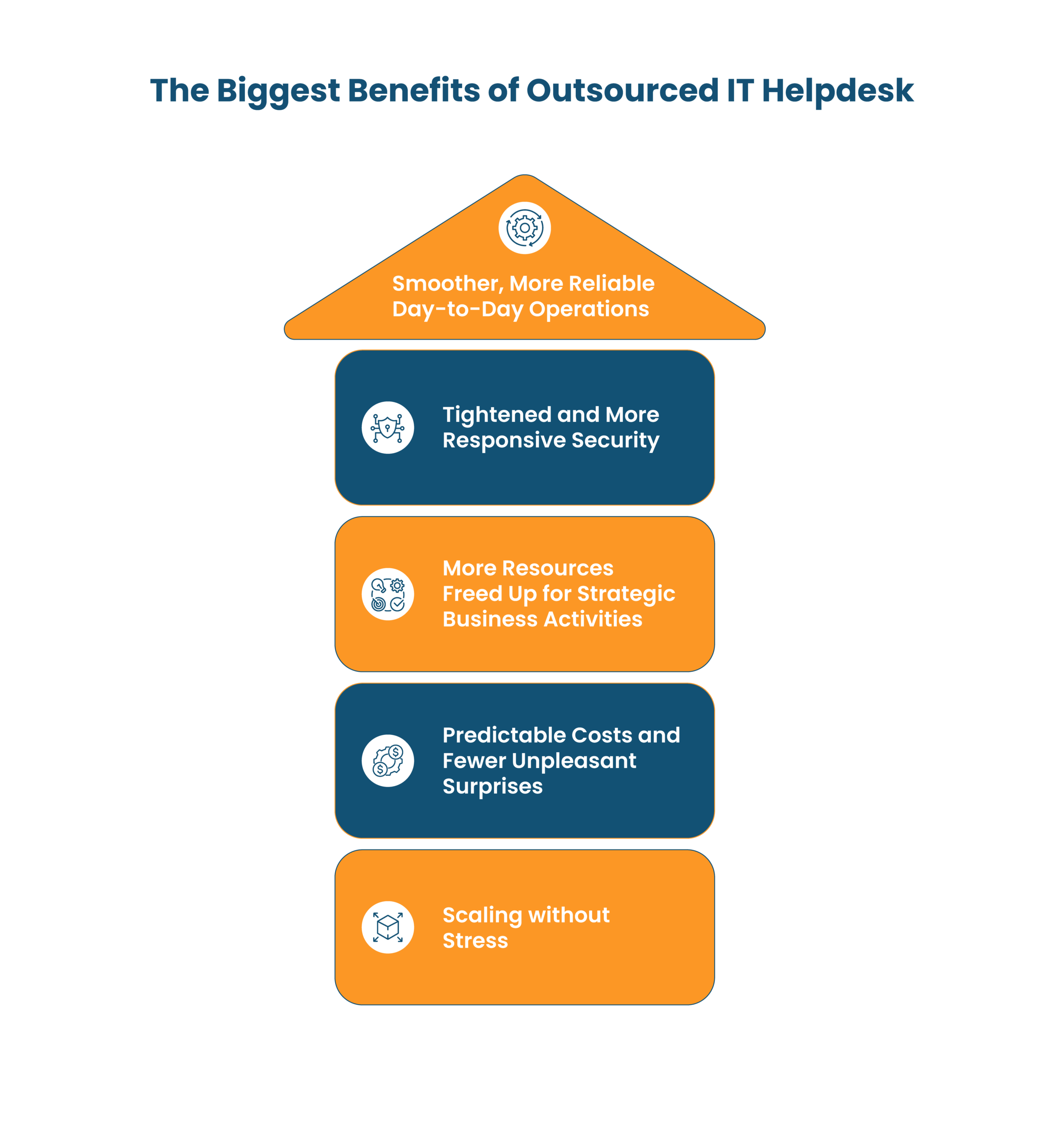
Choosing outsourced IT helpdesk support isn’t just about fixing tech issues faster or having someone else handle password resets. For most small and mid-sized businesses, it’s all about smoother operations, stronger systems, and more breathing room to focus on real business goals.
When support is handled by people who do this every day, the business stops reacting to problems and starts running with a sense of calm and continuity. Below are the biggest advantages that SMEs stand to receive from a proven outsourced IT helpdesk.
Smoother, More Reliable Day-to-Day Operations
When a company switches to an outsourced IT helpdesk, everyday work becomes a lot less chaotic. No more sudden “who-can-fix-this?” meetings or waiting for someone who “knows computers” to come in on the weekend. Instead, business hours are spent doing what matters.
Here’s what typically changes:
- Employees aren’t interrupted to solve tech issues they were never trained for.
- Downtime drops, because experts jump in immediately.
- Teams can focus on performance instead of worrying about whether the internet will go down again.
Over time, the company runs with fewer speed bumps, processes start flowing, and employees work without the fear of system failure.
Tightened and More Responsive Security
Earlier, security was something that only big companies could afford to take seriously. Today, businesses of all sizes are targets, whether they realize it or not. Outsourced IT helpdesk support empowers businesses by offering them watertight protection instead of hoping for the best.
A professional outsourced team typically delivers:
- Round-the-clock monitoring
- Immediate patching and updates
- Proactive detection of unusual activity
- Real-time alerts for anything suspicious
There’s also the matter of compliance. Many industries now require businesses to follow strict data, privacy, and security regulations. An outsourced team helps a company stay aligned without stressing over every upcoming standard. Even something as simple as reliable data backups becomes a non-negotiable part of daily IT practice.
This doesn’t mean cyber risk disappears forever. It means it becomes controlled and manageable. For the business owner, that usually translates to peace of mind and fewer “what if…” worries.
More Resources Freed Up for Strategic Business Activities
Yet another underrated benefit of an outsourced IT helpdesk is: the workforce finally gets more time for doing business-related tasks. When tech support is handled externally, employees can stop juggling unrelated tasks and focus on their roles.
Typical improvements include:
- Faster task execution
- No waiting for internal fixes
- More bandwidth for customer work
- No employees pulled away from their primary responsibilities
In other words, operations become more efficient not because employees suddenly work harder, but because they stop being forced to wait or work outside their expertise.
Predictable Costs and Fewer Unpleasant Surprises
Internal IT often means unpredictable budgeting. Why? The system breaks, costs pile up, and suddenly a minor issue snowballs into a major expense.
With outsourced support, however, costs become structured and predictable. The company knows what it’s paying each month, and emergencies become far less frequent.
Additionally, budget forecasting gets easier, and financial planning becomes less stressful. It’s not just cost saving; it’s cost stabilizing.
Scaling without Stress
Growth is exciting until the infrastructure starts to seem unsupportive. Instead of hiring new IT staff, sourcing devices, or retraining the team, outsourced IT helpdesk support scales smoothly alongside the company. As demand grows, support expands behind the scenes without slowing anyone down.
This means:
- No delays in expansion
- No onboarding of new IT hires
- No interruptions as systems scale
Basically, the company grows, and the IT support grows with it.
Signs Your Business Is Ready to Outsource Its IT Helpdesk
Here’s an unfortunate reality: For most businesses, outsourcing the IT helpdesk support comes after months (or years) of friction, i.e., small issues piling up until they start slowing down operations.
Some of the biggest warning signs look like:
- IT costs creeping up month after month
- Employees waiting too long for problems to get resolved
- The internal team drowning in tickets instead of working on real projects
- Systems breaking down more often or running on outdated hardware and software
- No structured process for ticket handling, monitoring, or follow-up
If these situations sound familiar, it’s probably time to start thinking differently.
Outsourcing eliminates the cycle of tackling problems only after the damage is done. The best thing about outsourced teams is that they put processes and monitoring in place right at the start, so many issues get addressed before the user even notices them.
This shift is especially important for maturing companies. That’s because the IT setup that worked for a smaller team almost never works when the workforce expands. Calling in specialists means the business doesn’t have to keep reinventing its IT wheel every six months.
The biggest advantage? Leadership finally gets headspace again. Instead of being dragged into every IT escalation, they can step back, plan, and move forward.
Simply put, the right kind of outsourcing becomes less about fixing computers and more about giving the leadership room to operate smoothly and confidently.
How to Choose the Right Managed IT Partner
Outsourcing only works when the external team feels like an extension of the business. Partnering with the right managed IT services provider is, therefore, crucial. Here are the qualities smart companies look for in their IT helpdesk support team:
- Transparency: Clear reporting, no hidden charges, and no vague “we’re working on it” replies.
- Faster response times: If the provider can’t intervene quickly, all the technology in the world won’t matter.
- Certified and experienced staff: You want people who’ve resolved real-world issues, not just textbook ones.
- Proven processes and SLAs: Structured operations mean predictability and quality.
- A positive track record: Client feedback, testimonials, and measurable results matter.
Beyond qualifications, the right partner should understand the company’s culture, goals, pace, and challenges. They shouldn’t only fix tickets; they should communicate, advise, guide, and offer clarity.
Conclusion
Outsourcing IT support is a practical way for SMEs to build stability, efficiency, and better control over daily operations without expanding their internal team. With the right outsourced IT helpdesk, issues are handled faster, small problems don’t delay the work, and the business can grow without technical interruptions.
Infrassist provides professional outsourced IT helpdesk support built around real needs, clear processes, and experienced specialists. Our approach helps companies stay productive, secure, and focused on their goals instead of constantly troubleshooting.
If you’re looking to simplify your IT workload and improve the way your business runs, feel free to explore Infrassist’s services today. We’re eager to hear from you.