A firewall, in the absence of monitoring, is a passive piece of infrastructure. It follows the rules it was given on day one, blocks what it was told to block, and logs everything without anyone necessarily reading those logs. For businesses that assume their network is protected simply because a firewall is in place, that assumption carries more risk than most realize.
24/7 firewall monitoring is what turns static control into an active defense. The difference between the two is not just technical, but operational.
That’s what sets the pace for catching threats fast. A misconfiguration nipped early keeps things from blowing up, and compliance audits don’t turn into nightmares.
The Business Problem That Monitoring Solves
Most network breaches do not happen because a firewall was absent. They happen because no one was watching it closely enough. Firewall rules get added and rarely cleaned up. Configurations drift over time. Threats probe for weaknesses at hours when internal teams are not available, and without continuous oversight, there is no mechanism to catch what slips through.
The gap that 24/7 firewall monitoring fills is not just about coverage hours. It is the continuous translation of raw network activity into meaningful security intelligence. Without that translation, a business is managing risk blindly. A few realities make this more concrete:
- A large share of intrusion attempts happen outside business hours, particularly over weekends. In-house teams that monitor during office hours are simply not present when many of these occur.
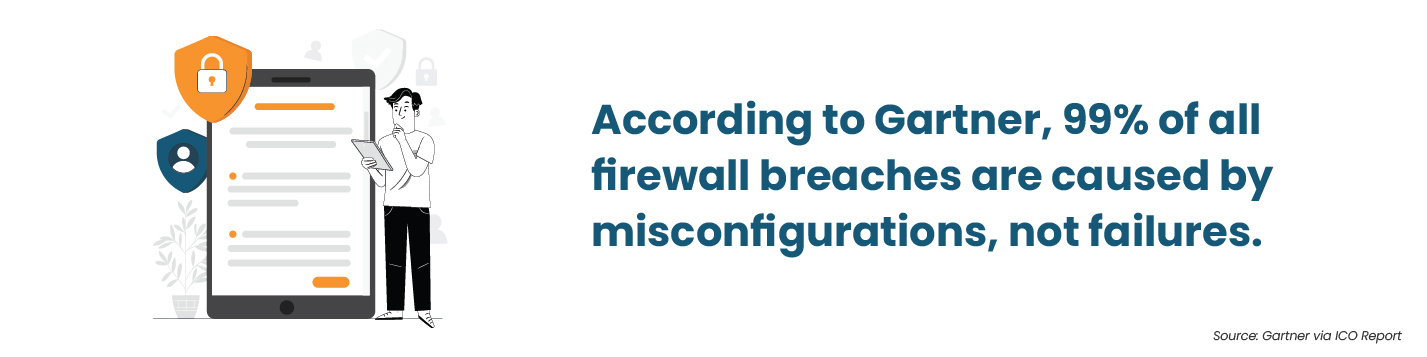
- Firewall misconfiguration heads the list for network breaches. It’s those rules you added for a short-term need and then revisited. Access policies? They go unchecked year after year. Slowly but surely, the whole attack surface stretches out wider than it should.
- Regulatory frameworks like PCI-DSS, HIPAA, and SOC 2? They want hard proof you’ve got continuous monitoring going. A review here and there doesn’t cut it. Come audit time, you’re caught short, and the fines don’t stop at IT because they hit the entire business hard.
- The average network breach recovery costs, including downtime, remediation efforts, and reputational damage, far exceeds the annual cost of managed firewall security services.
What Does 24/7 Firewall Monitoring Cover
This is where, more often than not, expectations deviate from reality. Many organizations believe that having a firewall with logging enabled is effectively the same as monitoring. It is not. Logging generates data. Monitoring makes sense of it, continuously and with the intent to act. A properly structured firewall monitoring service covers the following:
Log Analysis and Threat Detection
Every access attempt, blocked packet, rule trigger, and policy violation creates a log entry. Monitoring means sifting through these logs round the clock to catch threat patterns right away, not peeking at them now and then or only after something goes wrong.
Traffic Anomaly Detection
Unusual spikes in outbound data transfers, repeated access attempts from a specific source, or lateral movement within a network are all indicators that need to be caught in near real-time. A monitoring service identifies these anomalies and escalates them to the appropriate people without delay.
Configuration Change Tracking
Any modification to firewall rules, authorized or otherwise, is captured and reviewed. Unauthorized configuration changes are among the more reliable early indicators of a compromised or at-risk environment, and catching them early is far less costly than addressing them after the fact.
For organizations with Active Directory in the mix, how AD authentication integrates with firewall rules is a configuration area that warrants its own tracking discipline.
Alert Triage and Escalation
Far too many firewall alerts turn out to be false positives, not genuine security incidents at all. When teams face that kind of relentless volume without a proper triage system in place, alert fatigue inevitably takes hold and leaves everyone exhausted.
Real threats end up slipping right past because of it. Reliable monitoring services filter through the irrelevant noise, zero in on issues that actually require immediate attention, and guarantee that valid incidents land directly with the appropriate personnel before they disappear under a pile of distractions.
Compliance and Audit Reporting
For businesses operating in regulated industries where compliance is non-negotiable, firewall monitoring services generate structured reports that thoroughly document the overall security posture over extended periods of time. This approach ensures that audit preparation becomes far from a last-minute scramble or frantic rush, since all the required evidence of continuous monitoring is already organized and in order precisely when it is needed most.
Patch and Vulnerability Tracking
Firewall firmware and software must stay current. Monitoring includes flagging outdated versions and known vulnerabilities before they become exploitable entry points, rather than leaving that discovery to chance or an annual review cycle.

The Case for Managed Firewall Services Over In-House Monitoring
The honest reality for most organizations is that in-house firewall monitoring comes with limitations that are difficult to overcome without significant investment. Internal IT teams juggle countless responsibilities every day, so dedicated, continuous firewall monitoring rarely takes center stage amid all the other pressing demands pulling their attention.
Alert fatigue proves a common yet often overlooked challenge here. Picture an internal team handling hundreds of alerts daily while keeping up with routine tasks. The thoroughness of their reviews naturally starts to slip under that pressure. None of this criticizes the teams themselves. It just reflects the reality of how things work in-house.
Managed firewall service providers set up their whole operation to solve this exact issue, and the differences really stand out when you break them down:
- Coverage: Real 24/7 monitoring, not just daytime watching with someone on-call for nights and weekends.
- Dedicated expertise: Teams living and breathing firewall monitoring every single day pick up instincts that take years to develop inside a company.
- Enterprise-grade tooling: Managed providers use firewall monitoring tools that cost a fortune for most companies to buy and run on their own.
- Scalability: Add new offices, more staff, or cloud setups, and managed services grow right with you. No need to hire extra people in proportion.
Growing businesses see it as clear as day. Managed firewall security services handle what internal teams just can’t keep up with once the network gets complicated.
For growing businesses, the gap between what managed firewall security services can deliver and what an internal team can sustain on its own becomes increasingly evident as the network environment grows in complexity.
Next-Generation Firewalls Raise the Stakes for Monitoring
Not all firewalls are built the same, and the firewall types businesses commonly deploy each carry different monitoring requirements worth understanding before evaluating a service.
The shift toward managed next-generation firewall services reflects a broader change in how modern networks operate. Next-generation firewalls go beyond port and protocol filtering. They inspect application-layer and encrypted traffic, integrate with threat intelligence feeds, and provide intrusion prevention capabilities, all of which generate a substantially higher volume of data than a traditional firewall.
Without structured monitoring, the more sophisticated capabilities of an NGFW are generating information that no one is acting on. For businesses that have invested in next-generation infrastructure, managed next-generation firewall services ensure that the investment is working in the organization’s favor, rather than sitting idle.
What to Look for When Evaluating Firewall Monitoring Services
Picking a firewall monitoring service deserves real thought. Coverage varies wildly between providers, and those gaps show up exactly when you need them most. Before signing anything, get straight answers on these:
How quick is their response on critical alerts?
SLAs need hard numbers, not vague promises open to excuses.
Proactive or just reactive?
Proactive catches trouble brewing and stops it cold. Reactive waits till you’re already hit, and that’s no small difference.
How are configuration changes handled?
A legitimate managed firewall security service should have an authorization process in place before any modifications are made to rule sets or policies.
What do reports look like for non-tech leaders?
If a provider can’t break down network events into plain language that executives grasp right away, that’s a red flag to watch before any contract gets signed.
What firewall environments does the provider have experience with?
Whether you’re running Cisco, Fortinet, Palo Alto, pfSense, or some combination, the provider needs to show real hands-on experience with your exact setup.
Managed firewall service pricing changes depending on how complex your environment is, how many devices they manage, and what level of service you pick. Managed firewall services comparison helps narrow your choices. Ask for a full breakdown of covered items versus extras, way better than just eyeing the top-line numbers alone.
Firewall as a Service and What It Changes for Mid-Market Businesses
Firewall as a service has made enterprise-grade protection more accessible than it has been historically.
Instead of buying on-premise hardware, hiring dedicated staff, and paying endless licensing fees, businesses turn to firewall-as-a-service providers for monitoring and management on a steady monthly bill, minus massive upfront costs to swallow.
Mid-market companies feel this shift the most, since their security demands always outstrip what resources they can spare.
Affordable firewall-as-a-service solutions bring enterprise-level protection—once a budget-buster, right into range for smaller operations that never could afford those high-end setups.
The catch with firewall as a service? It’s fully managed, so you’re counting on the provider’s gear and procedures to keep things tight. That’s why checking their monitoring habits, response promises, and compliance know-how matters big time before you lock in.
Stay Ahead of Firewall Risks Before They Escalate
Infrassist’s team delivers continuous monitoring, expert analysis, and rapid response to keep your firewall actively protecting your business.
Making the Decision
For businesses handling sensitive data, serving customers through digital channels, or operating in industries with regulatory obligations, 24/7 firewall monitoring is not a discretionary expense. It is a baseline operational requirement that the business either meets or accepts meaningful risk in not meeting.
The organizations that treat firewall monitoring as a key and ongoing operational function, rather than a setup-and-forget activity, tend to respond faster when incidents happen, face less trouble during compliance reviews, and maintain much lower risk across their entire network security setup.
If the current arrangement is a firewall that was configured some time ago and reviewed occasionally, it is worth understanding what continuous monitoring would actually change.
Working through a firewall audit checklist makes perfect sense as your first move before settling on any monitoring solution. That initial review uncovers exactly what needs attention most in your current setup before you commit to any new monitoring arrangement.
Organizations wanting to evaluate their options more broadly should study what the top managed firewall services bring to the table, covering exactly what capabilities to look for and how different providers tackle these challenges in their own way.