Picture this: You’re running a growing MSP. Clients are coming in, tickets are moving, revenue looks healthy.
Then, at 1:40 AM, a critical alert fires only to go completely unnoticed.
By morning, a small issue has turned into downtime, client frustration, and a long day of cleanup. You try to fix it, push the team harder, and even consider hiring additional staff to make things work. But a week later, it happens again.
That’s when it clicks. The problem isn’t effort. It’s coverage, consistency, and scale.
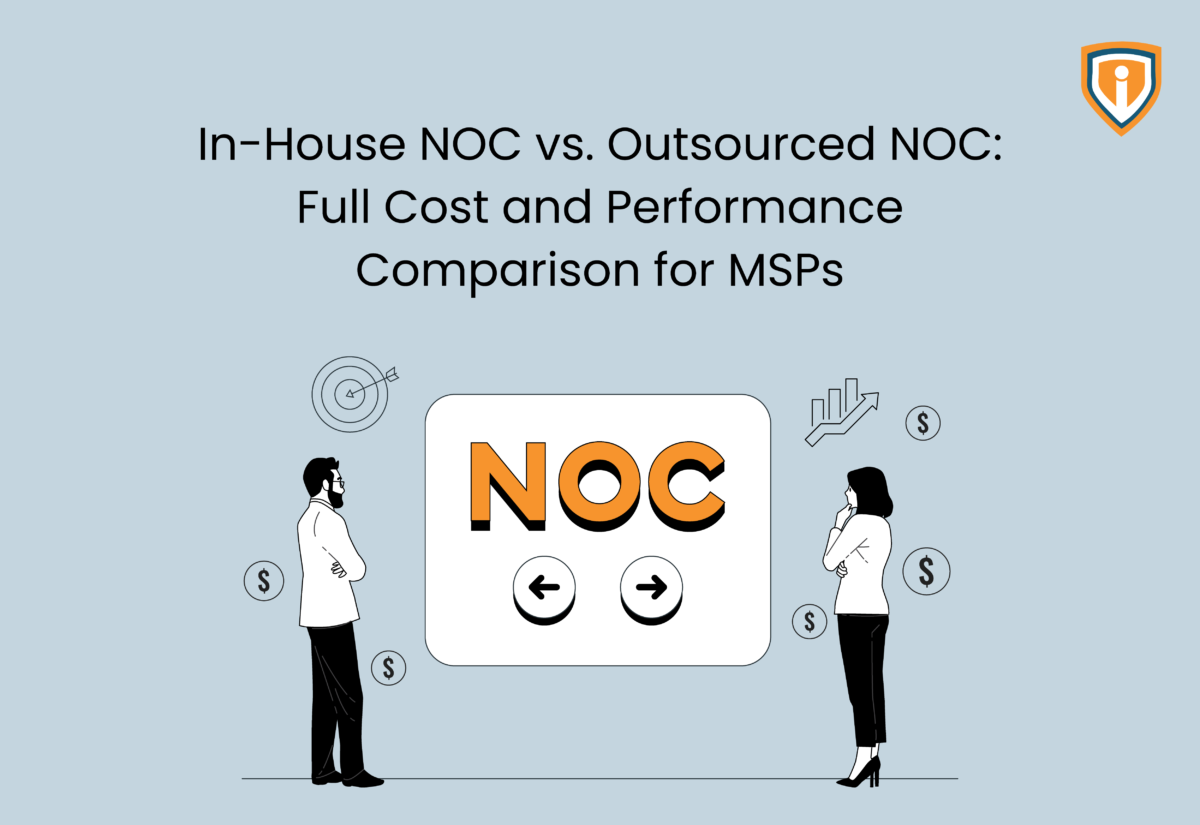
No wonder the in-house vs outsourced NOC comparison is becoming increasingly prevalent in modern times!
Do you keep building internally, or shift to managed NOC services via an outsourced NOC model designed for 24/7/365 operations? Because at the end of the day, MSP network monitoring is all about keeping your business operations from going awry.
In this post, we’ll consider the key differences between in-house and outsourced NOC models so you can decide what’s best for your business.
What Is a NOC in an MSP Environment?
Before you get lost in the in-house vs outsourced NOC comparison, let’s understand what a NOC actually does when the day gets tumultuous.
Think of it as the ever-supportive engine room. When everything’s running fine, you barely notice it. But should an operation derail, everything gets impacted by it.
On a typical day, a NOC handles:
- 24/7 monitoring and alert management, so issues are intercepted before they spiral
- Incident response and escalation, because not every problem can wait till morning
- Patch management and routine maintenance, and the unglamorous work that keeps systems from stagnating
- Network and infrastructure health checks, making sure everything is tidy under the surface
These are the essentials behind NOC monitoring services, whether they’re in-house or outsourced.
The ripple effect?
- SLAs stay intact.
- Clients stay calm.
- Your team isn’t stuck in a loop of applying temporary fixes.
Basically, a robust NOC keeps the whole operation from quietly falling apart.
In-House NOC: Full Breakdown
If you really think about it, building an in-house NOC sounds straightforward until you’re knee-deep in it.
What Building an In-House NOC Actually Involves
It’s not just about hiring technicians and calling it a day. Building a NOC involves adding an entire operational layer from scratch, one that can hold up under pressure at any hour.
Here’s what this looks like:
- Hiring across levels: L1 for monitoring, L2 for troubleshooting, L3 for complex issues
- Creating true 24/7/365 coverage through shifts or on-call rotations
- Setting up tools like RMM, PSA, and monitoring systems that work cohesively
- Building documentation, security protocols, and access controls that work under stress
- Defining SOPs, escalation paths, and workflows so issues can be resolved as soon as possible
This is the reality behind internal MSP network monitoring. Yes, it’s all about operational discipline, every single day.
The Real Cost of an In-House NOC
The obvious costs are easy to spot but the inconspicuous ones can leave businesses surprised.
Here’s where the money actually goes:
- Salaries and benefits, which usually make up 60 to 70 percent of total NOC costs
- Tool licensing and integrations across multiple platforms
- Ongoing training and certifications to keep up with evolving tech
- Infrastructure and overhead, including office space, hardware, and security
- Attrition cycles, where one resignation triggers hiring delays, onboarding time, and lost productivity
Operational Challenges You Can’t Ignore
As your MSP grows, your NOC doesn’t just scale, but stretches.
- Every new client adds complexity, which means more hiring
- Nights and weekends create coverage gaps unless you overstaff
- Burnout builds quietly, leading to slower response times and inconsistent performance
- Management overhead increases as you try to keep everything aligned
The NOC performance metrics can start slipping at this point, especially if the system is under constant strain.
Where In-House NOC Wins
For all its challenges, an in-house NOC still has its place. Here’s how:
- You have full control over processes, priorities, and execution.
- Your team is deeply aligned with your culture and way of working.
- Customization is easier, especially if you serve niche or highly specific client environments.
If you have the scale, budget, and leadership bandwidth to support it, an internal NOC can be powerful. But it demands consistency at scale, which is where things tend to get tested.
Outsourced NOC: Full Breakdown
If building in-house feels like assembling an engine piece-by-piece, an outsourced NOC is like stepping into a car that’s already running.
How an Outsourced NOC Works
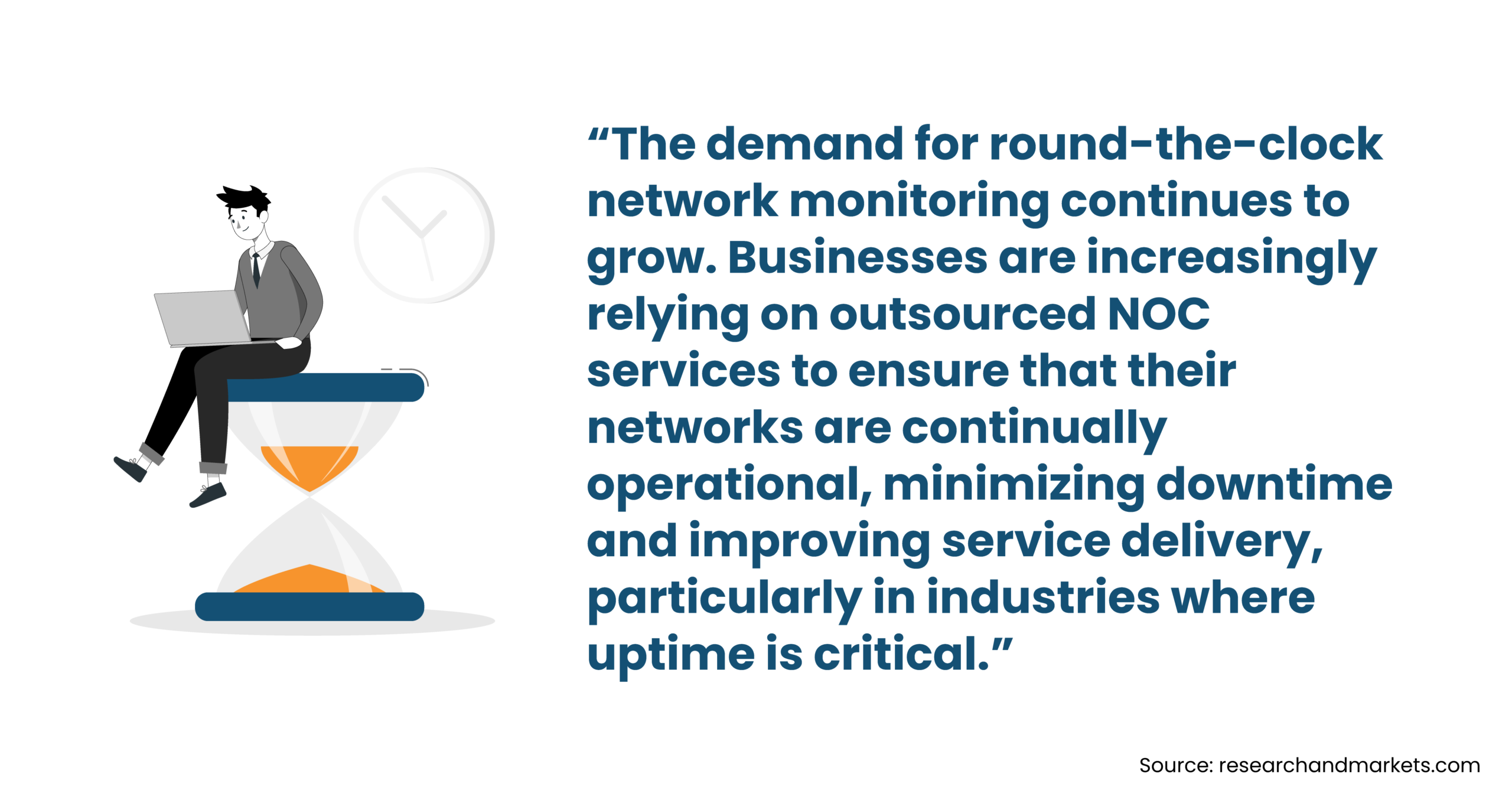
Instead of hiring, training, and managing everything internally, MSPs partner with providers who specialize in NOC services for MSPs. These teams handle the day-to-day operational load while you stay focused on growth and client relationships.
Here’s how it typically works:
- An external team takes over monitoring, alert management, and routine operations.
- Services are delivered under your brand through white label NOC services, so your clients never see the backend.
- The provider integrates with your existing RMM, PSA, and workflows, so there’s no need to rebuild your stack.
- Support is structured to align with your processes, escalation paths, and SLAs.
In essence, you’re plugging into a fully built outsourced network operations center without putting in the effort of building one yourself.
The Real Cost of an Outsourced NOC
Unlike in-house setups where expenses keep stacking, outsourced NOC services follow a more predictable model:
- Fixed monthly pricing or per-device/per-endpoint billing
- No hiring, onboarding, or training costs
- Reduced spending on tools, since many providers include or optimize existing systems
- Lower overhead, with no infrastructure or HR burden
For most MSPs, this translates into stable, forecastable spending. This is precisely where network monitoring outsourcing starts to feel less like an expense and more like operational control.
Performance Advantages That Matter
With managed NOC services in your corner, you’re moving way past building coverage. In fact, that aspect already runs 24/7/365. Here’s what you get:
- Immediate round-the-clock monitoring with no gaps
- Faster response and resolution times due to dedicated teams
- Access to experienced engineers who’ve handled a wide range of environments
- Built-in scalability that doesn’t depend on hiring cycles
Because these providers live and breathe MSP network monitoring, their systems are designed for consistency, which is what keeps NOC performance metrics stable.
Potential Trade-Offs to Consider
Like any partnership, an outsourced NOC comes with trade-offs:
- You give up a minimal level of direct, day-to-day control over execution.
- Your results depend heavily on the provider’s quality and communication.
- Success requires strong SLAs, clear onboarding, and tight alignment from day one.
When these pieces are connected, the model delivers reliability without constantly stretching your team.
Side-by-Side Comparison: In-House vs Outsourced NOC
Once you move past theory, the in-house vs outsourced NOC comparison really comes down to how each model behaves under pressure.
Cost Comparison
Let’s start where most decisions begin: money.
In-house:
- Requires high upfront investment in hiring, tools, and setup
- Ongoing costs grow with team expansion and operational complexity
- Hidden costs show up through inefficiencies, downtime, and attrition cycles
Outsourced:
- Lower initial investment with minimal setup friction
- Predictable monthly pricing through outsourced NOC services
- Fewer surprise costs, since hiring and training are off your plate
Performance Compensation
This is where expectations meet reality.
In-house:
- Performance depends heavily on team size, experience, and internal processes.
- Can fluctuate during hiring phases or periods of rapid growth
- Consistency often takes time to build.
Outsourced:
- SLA-driven delivery backed by managed NOC services
- Stable performance from day one, with defined response and resolution benchmarks
- Optimized for consistent MSP network monitoring without internal bottlenecks
Scalability Comparison
Growth sounds great until operations have to keep up.
In-house:
- Scaling requires hiring, onboarding, and training, which slows momentum.
- Expansion often comes with temporary service strain.
Outsourced:
- Scales almost instantly with demand through an outsourced network operations center
- No hiring delays, no ramp-up lag
Risk Comparison
Every model carries risk, but the real difference is in which one handles it better.
In-house:
- Heavy reliance on key individuals and internal knowledge
- Attrition can disrupt operations and impact NOC performance metrics
Outsourced:
- Dependency shifts to the provider’s reliability
- Risks are managed through contracts, SLAs, and structured delivery models
When Should You Choose In-House NOC?
Going in-house makes sense when you have the financial and operational muscles to support it long-term. You’ll need a:
- Strong budget to absorb hiring, tools, and ongoing overhead
- Stable, predictable workload that doesn’t swing wildly
- Need for deep customization or niche technical expertise
- Willingness to actively manage hiring, training, and retention
In this version of the in-house vs outsourced NOC comparison, control is the biggest win. But it comes with responsibility. You’re building and maintaining the system yourself, and there’s no shortcut around that.
When Should You Choose Outsourced NOC?
This route starts making sense when speed, consistency, and efficiency take priority over control. Outsource when you’re dealing with the following:
- Need for immediate 24/7 coverage without building shifts
- Rapid growth that hiring simply can’t keep up with
- Pressure to keep costs predictable through outsourced NOC services
- Urgent need to improve SLAs and stabilize MSP network monitoring
With managed NOC services and an outsourced NOC, you’re not catching up. You’re essentially plugging into something that’s already running at scale.
Hybrid Approach: The Middle Ground
Some MSPs don’t pick sides. They split the load and divide it in the most suitable and feasible ways. Let’s find out what that might look like.
Keep in-house:
- Client-facing communication
- Complex, high-touch, or business-critical issues
Outsource:
- Monitoring and alert management
- Routine maintenance and patching through white label NOC services
The result is balance.
- Reduced internal workload without losing visibility
- Better focus for your core team
- Stronger operational rhythm without constant strain
In the in-house vs outsourced NOC comparison, this is often the most practical setup for growing MSPs.
Stop Chasing Issues. Start Scaling.
Infrassist’s 24/7 managed NOC services bring consistency, speed, and control to your operations.
Conclusion
At some point, every MSP runs into the same question: Do you keep building internally, or shift toward a model that’s already built to scale?
This in-house vs outsourced NOC comparison makes one thing clear. In-house gives you control, but demands time, money, and constant management. An outsourced NOC offers consistency, faster response, and predictable costs through managed NOC services.
If your goal is to stabilize operations without overwhelming your team, it might be time to rethink how your NOC runs.
Infrassist can help. With reliable NOC services for MSPs and fully aligned outsourced NOC services, we help you stay ahead without burning out your team or slowing down growth.